


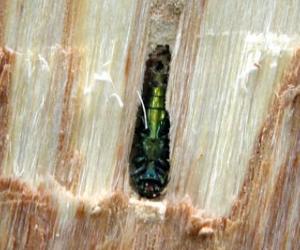
The Wisconsin Department of Natural Resources (DNR) is considering the need to alter the classification of emerald ash borers as their infestation in Wisconsin's forests has increased.
The emerald ash borer has become widespread in North America over the last several years, with the destructive insect spreading throughout the US and Canada. It burrows deep under the bark of ash trees to lay its eggs, and when the larvae hatch they begin to feed on the tree from the inside until the tree dies.
Since the ash borer is an invasive species, there are no predators in place to control the insect's growing numbers, resulting in widespread damage to ash trees throughout the continent.
The Wisconsin DNR has an invasive species catalog that was created five years ago. It features emerald ash borer and several other insect, plant and animal species as unwelcomed guests.
The list features two distinctions that includes prohibited species and restricted ones. Under DNR guidelines, prohibited species are banned from being sold, possessed or transported. Moreover residents are legally obligated to destroy any specimens of a prohibited species discovered on their property.
This holds opposite views from the way restricted species are handle, while they're also barred from transport or sale, it's not required to destroy any specimens. According to DNS, the ash borer infestation is simply too great to expect property owners to destroy the insect whenever it's found.
Out of the 72 counties that make up Wisconsin, the DNR says that the tree-destroying insect has been found in 28 of them so far.
Most US states are trying to limit ash borer populations through geographical isolation. People have been warned not to transport live ash trees or firewood originating from the tree out of their neighbourhood to help slow the spread of the insect.
A team of scientists have been able to unravel the mystery surrounding thechameleon's ability to change colours.
The new study showed that chameleons are able to adjust a layer of specialized cells that are just beneath their skin's...

A new study by the Massachusetts Institute of Technology (MIT) has revealed that Istanbul lies...

The Michael J Fox Foundation is aiming to test wearable sensors in smart watches made by Intel's...

In January, trade surplus of Germany decreased since plunge in imports was more than a drop in exports. According to the Federal Statistical Office, exports dropped 2.1% in January to 96.3 billion euros ($105.57 billion) when adjusted for...

American Toymaker company Mattel on Thursday reported 21% decline in sales during the third...

The Google Glass Explorer edition is now available across the Google Play store across the US....

German retailer Metro AG witnessed a slow start to the Christmas season in its home market. But Metro affirmed that it is expecting 'satisfactory' Christmas trading as its operating profit was more than the expectations.
In the final...

A team of scientists have been able to unravel the...

Here’s good news for sky gazers as they will be able to...

According to some doctors, 2015 could be the most...
© 2011 AustrianTribune - Tribune Online Services. All times CET (GMT + 1.00).


