


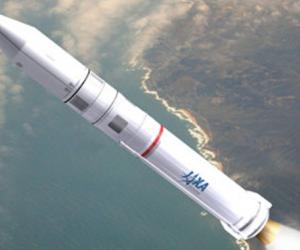
The Japan Aerospace Exploration Agency (JAXA) announced the launch of a new generation weather satellite ,Himawari-8 on Oct. 7 from the Tanegashima Space Center aboard an H-2A carrier rocket at 14:16 local time (05:16 UTC).
The satellite is built by Mitsubishi Heavy Industries of Tokyo and will observe weather conditions from geostationary orbit at 140 degrees east longitude. It will replace Himawari 7, which has been in orbit since 2006. It will shoot images every 10 minutes compared with every 30 minutes by the Himawari-7.
According to Japan Meteorological Agency, it is equipped with highly improved sensor, Advanced Himawari Imager to further support and improve meteorological services in a variety of fields such as weather forecasting, climate monitoring, natural disaster prevention and safe transportation.
The satellite's main sensor was built by Exelis Geospatial Systems of Rochester, New York. It is similar to the Advanced Baseline Imager (ABI) developed by Exelis for the U.S. National Oceanic and Atmospheric Administration's next generation of geostationary-orbiting weather satellites.
Eric Webster, vice-president for weather systems for Exelis, said, "We are all excited to get the ABI technology launched into space. In addition to providing Japan with improved weather forecasting information, the Himawari-8 sensor will give NOAA experience in working with ABI-class data".
Himawari-9, scheduled to launch in 2016, is identical to Himawari 8 and will take over as the on-orbit backup before replacing Himawari 8 around 2022.
Himawari-9 will make observations with greater frequency and in more spectral bands than the Multifunctional Transport Satellites they were designed to replace. According to the information posted on Japan Meteorological Agency website, this will provide unprecedented precision in monitoring not only clouds and other weather conditions but also volcanic ash and atmospheric aerosols.
Tuesday's launch was the 25th flight of the H-2A rocket and the vehicle's 19th consecutive success.
In January, trade surplus of Germany decreased since plunge in imports was more than a drop in exports. According to the Federal Statistical Office, exports dropped 2.1% in January to 96.3 billion euros ($105.57 billion) when adjusted for...

A new study by the Massachusetts Institute of Technology (MIT) has revealed that Istanbul lies...

The Michael J Fox Foundation is aiming to test wearable sensors in smart watches made by Intel's...

In January, trade surplus of Germany decreased since plunge in imports was more than a drop in exports. According to the Federal Statistical Office, exports dropped 2.1% in January to 96.3 billion euros ($105.57 billion) when adjusted for...

American Toymaker company Mattel on Thursday reported 21% decline in sales during the third...

The Google Glass Explorer edition is now available across the Google Play store across the US....

German retailer Metro AG witnessed a slow start to the Christmas season in its home market. But Metro affirmed that it is expecting 'satisfactory' Christmas trading as its operating profit was more than the expectations.
In the final...

According to a new study, each hour spent sitting may...

In January, trade surplus of Germany decreased since...

According to a new research at the University at Buffalo...
A team of scientists in Australia have developed a way...
© 2011 AustrianTribune - Tribune Online Services. All times CET (GMT + 1.00).


