


Charles Darwin, an English naturalist and geologist best known for his contributions to the science of evolution, asked his readers to consider their own hands in order to help better understand human evolution.
Darwin asked what can be more curious than that the hand of a man, formed for grasping, that of a mole for digging, the paddle of the porpoise, the leg of the horse, and the wing of the bat, should all be constructed on the same pattern. Besides, these should include similar bones in the same relative positions.
The renowned geologist had a simple explanation to offer that people, moles, porpoises, horses and bats have an ancestor in common that had limbs with digits. Its descendants evolved varied limbs as necessitated for various tasks. However, they never lost the anatomical similarities that linked them to each other.
In order to figure out these similarities, Darwin used a crude microscope, which was the most sophisticated equipment he could use for the task at that time.
Researchers at the University of Chicago on Wednesday reported that our hands have a deep evolutionary connection in common not only with bat wings or horse hooves, but fish fins too.
The finding is expected to help researchers understand how our own ancestors left the water, a development that transformed fins into limbs that they could use to move around on land.
“To the naked eye, there is not much similarity between a human hand and the fin of, say, a goldfish. A human hand is at the end of an arm. It has bones that develop from cartilage and contain blood vessels. This type of tissue is called endochondral bone”, said Neil H. Shubin, an evolutionary biologist who runs a lab at the University of Chicago.
According to a report in Discover Magazine by Nathaniel Scharping, "Fossils such as Tiktaalik, one of the most compelling members of the class of transitional “lobe-finned fishes”, mark the evolutionary path that led to land-bound animals. The transition from delicate fins to sturdy limbs didn’t happen all at once, but it is clear that our appendages are distant cousins of fish fins."
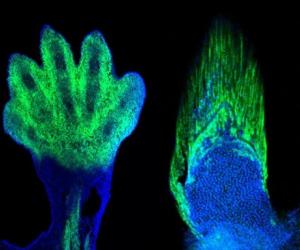
The scientists combined their knockout technique with a process called fate mapping, which follows the development of a group of cells from embryo to adult. They marked the embryonic cells with a fluorescent protein that tracked the movement of the cells as they grew and shifted into position in the developing fins. The dual approach identified the group of cells responsible for giving us hands and fingers or fish fins, and made it clear that the same group of cells played a key role in both developmental processes.
The same cells that in mammals form hands and fingers are clustered at the very end of fins in gauzy structures known as fin rays. This was a surprise to the researchers because no one had ever linked fin rays to mammal digits before. The researchers published their work Wednesday in Nature.
A report published in Engadget informed, "Gene editing technology isn't just useful for curing the world's ills, it seems. University of Chicago scientists have used the CRISPR technique to discover a key evolutionary connection between fins and hands. Researchers edited fin-related zebrafish genes to make the appropriate cells glow as they develop, and discovered that there's a similar glow in a mouse's digits. In other words, there's a strong similarity in the genes governing fins and digits -- they're both telling embryonic cells to show up at the end of an appendage."
The finding suggests that the biggest difference between a fin and a hand may be the tissue involved, such as the dermal bone in fish or the endochondral (cartilage-based) bone in humans. That, in turn, helps explain intermediary species where fins grew increasingly limb-like. And it's safe to say that the CRISPR work raises hope of using gene editing to spot other evolutionary patterns. Aspects of biological development that have remained mysterious for decades might become a little bit clearer.
In commemoration of its 50th birthday on August 22, 2016, bigwig electronics retailer Best Buy has announced 50 "Black Friday-like deals."
The 50th birthday celebrations by Best Buy will involve major discounts on 50 products for 50 hours...

A new study by the Massachusetts Institute of Technology (MIT) has revealed that Istanbul lies...

In an announcement made at the Intel Developer Forum held in San Francisco on Tuesday, bigwig...

Reportedly, Hawaii Martin Mars, the world's largest flying water bomber will not perform on Saturday at the EAA air show.
The plane was on its way to the show when one of the check engine lights of the four engine plane came on. To inspect...

The drought conditions in California is widening economic split in California. The prospect of...

In an announcement made at the San Diego Comic-Con on Thursday, tech giant Google said that it...

In recent years, gender gap in pay has been a hot topic of discussion. On Wednesday, Amazon. com Inc said its female employees are paid equally as their male counterparts. The results which came from a recent survey were disclosed under pressure...

On Sunday, Catherine, the Duchess of Cambridge gave a...

It took rescuers with the Canadian Whale Institute on...

Opioid addiction has remained a hot topic of discussion...

Initiatives taken to deal with childhood obesity in...
© 2011 AustrianTribune - Tribune Online Services. All times CET (GMT + 1.00).


