


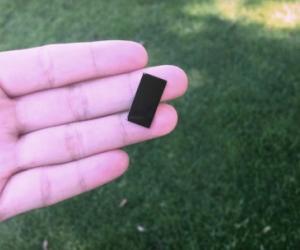
Stanford University scientists have devised a tiny contraption to disinfect water using light from the sun. They also claimed that the new device is capable of making water able to drink in just a few moments.
The new work is a result of combined efforts by Stanford University researchers and experts at the SLAC National Accelerator Laboratory of the Department of Energy. The device is so small that its dimension is 1 cm by 2 cm. In other words, it’s just half the size of a postage stamp.
The device looks like a tiny tablet, but it cleans the water efficiently using sun’s rays in a jiffy, explained the researchers. They believe the invention could be life-saver for those hikers who are looking for pure water during their voyage.
Traditional way to purify the water is boiling, but the Stanford device may soon become the best method to get clear water that could be drunk. Another interesting about the tablet is that it gives you neat water in just few minutes.
The device may be a game-changer in several regions around the world that are struggling to get pure drinking water. Today, more than 660 million worldwide people are forced to drink dirty and unhealthy water. In addition, more than 100 kids are losing their lives every day just because of unsanitary conditions of the water supply. The device could solve these water problems and may save several lives every day.
The table is with a topping of small amounts of copper. In addition, nanoflakes of the lubricant molybdenum disulfide coat its exterior. In just 20 minutes, it can kill more than 99% of bacteria in a 25 ml water sample, said the researchers. Moreover, the cost of purification is merely a few dollars.
According to a report in The Verge by Ashley Carman, "Using the sun to disinfect water is nothing new; UV rays start killing bacteria after six hours, although the process can take up to 48 hours. It's time-consuming, but often the only option in developing countries. Researchers at the Department of Energy's SLAC National Accelerator Laboratory and Stanford University's Institute for Materials and Energy Science created a device to speed up that process."
The device is made of glass and invisible layers of molybdenum disulfide. That compound becomes a photocatalyst that produces hydrogen peroxide (a disinfectant) when hit with visible light. In this case, the device killed
99.99 percent of bacteria after 20 minutes of use in 25 milliliters of water.
While this device is incredibly cheap and easy to manufacture, the researchers stipulate that they only tested it with lab-produced E. coli and lactic acid bacteria. It isn't proven to effectively destroy viruses or chemicals.
A report published in Mercury News informed, "Local scientists have created a cheap way to purify drinking water and potentially clean up polluted bodies of water, a feat that could greatly reduce illnesses -- and even deaths
-- in the developing world."
The device employs "nanoflakes" of molybdenum disulfide, an industrial lubricant that is cheap and easy to make, which when placed in direct sunlight triggers the formation of disinfectants. The device has only been tested on three strains of bacteria, but the research team theorizes it will work just as well on other strains, as well as other microbes, such as viruses.
Liu said researchers plan to conduct additional tests in rivers of developing countries before the device is sent for commercial production. SLAC publicist Andrew Gordon said the device likely wouldn't hit the market for another three to five years. So far, it has only been tested on bacteria mixed with water in a laboratory setting.
Jeff Williams, NASA’s astronaut on theInternational Space Station (ISS), will be accompanied by Kate Rubins on his fourth spacewalk on Friday. For Rubins, it is going to be her career’s first spacewalk. Both will remain out in the space for...

A new study by the Massachusetts Institute of Technology (MIT) has revealed that Istanbul lies...

In an announcement made at the Intel Developer Forum held in San Francisco on Tuesday, bigwig...

On Monday, automaker Audi announced that it is bringing vehicle-to-infrastructure (V2I) communication technology to some of its 2017 vehicles. The technology will give Audi’s 2017 vehicles the ability to notify drivers of the time for which they...

The drought conditions in California is widening economic split in California. The prospect of...

In an announcement made at the San Diego Comic-Con on Thursday, tech giant Google said that it...

In recent years, gender gap in pay has been a hot topic of discussion. On Wednesday, Amazon. com Inc said its female employees are paid equally as their male counterparts. The results which came from a recent survey were disclosed under pressure...

A new research has suggested that poor habits that take...

Many fish species get shelter and protection from coral...

Jeff Williams, NASA’s astronaut on theInternational...

Stanford University scientists have devised a tiny...
© 2011 AustrianTribune - Tribune Online Services. All times CET (GMT + 1.00).


