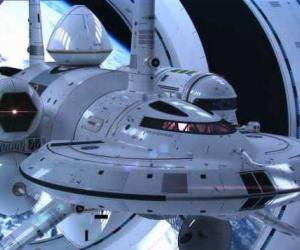
Researchers at NASA's Johnson Space Centre have tested an electromagnetic (EM) propulsion drive in vacuum that could practically facilitate space travel in and around the solar system.
In this new research, the scientists at NASA have successfully tested EM propulsion in a hard vacuum for the first time, while previous tests were conducted in atmospheric conditions.
The execution of the EM drive in vacuum, has defied the Newtonian Law of Physics. The Newton's Law of Conservation of Momentum has been challenged as the EM drive was productively undertaken in a closed cavity.
NASASpaceFlight.com reported that the EM drive could take a spacecraft to the moon in a matter of hours and even enable trip to Mars in 70 days.
The EM drive research is ongoing at several different agencies and across space agencies of various nations. The basic aim is to devise propellant-free propulsion system. Scientists in the American, British and Chinese space programs, all have been investigating methods to use electromagnetic microwaves to produce electrical energy which can be converted directly into thrust.
NASA's Eagleworks propulsion research group has been working since 2001 to invent a device, that can operate in a such closed cavity and can convert electrical energy directly into motion, without requiring fuel.
Dr. Richard White, Head of the Eagleworks group, clarified that propellant expulsion is not necessarily needed to balance the change in the momentum of the spacecraft. He explained, "EM Drive's thrust was due to the Quantum Vacuum behaving like propellant ions behave in a Magneto Hydro Dynamics drive for spacecraft propulsion."
This breakthrough in the domain of space travel has opened up fresh avenues of using alternative, virtual particles of quantum vacuum as a fuel source, thus, eliminating the cumbersome need of handling the propellant.
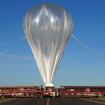
NASA's massive heavy-lift balloon which took off from Wanaka in New Zealand last month has been brought down before its scheduled landing over central Australia.
As per officials the 4000kg's of 'super pressure' balloon had to be brought...

A new study by the Massachusetts Institute of Technology (MIT) has revealed that Istanbul lies...

The Michael J Fox Foundation is aiming to test wearable sensors in smart watches made by Intel's...

LinkedIn, a business-oriented social networking service, has cut its full-year profit forecast, and even cited a slower growth at its hiring business.
Shares of LinkedIn fell by nearly 27% in after-hour trading on Thursday. LinkedIn’s...

Trina Solar (TSL), a Chinese manufacturer of photovoltaic module, posted its third quarter...

The Google Glass Explorer edition is now available across the Google Play store across the US....

German retailer Metro AG witnessed a slow start to the Christmas season in its home market. But Metro affirmed that it is expecting 'satisfactory' Christmas trading as its operating profit was more than the expectations.
In the final...

LinkedIn, a business-oriented social networking service...

According to researchers, there is a possibility that...
NASA's massive heavy-lift balloon which took off from...

A team of researchers have said that they have tested a...
© 2011 AustrianTribune - Tribune Online Services. All times CET (GMT + 1.00).