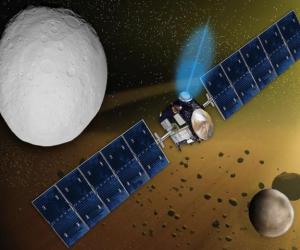
The US space agency NASA has released the first picture of Ceres, the largest celestial body in the asteroid belt between Mars and Jupiter. The first images of Ceres are of lower resolution and were taken by Dawn probe, which was launched in 2007, at a cost of $446 million. Dawn orbited the protoplanet Vesta, also in the asteroid belt, for more than a year before heading for Ceres, whose orbit it will enter in March 2015.
Jet Propulsion Laboratory, which supervises Dawn mission, said that Ceres was 740,000 miles away from the probe when the 9 pixel photo was taken. Ceres has been previously photographed by the Hubble Space Telescope but not at such a close range.
Ceres was discovered by Giuseppe Piazzi in 1801. Its classification has undergone several changes over time as so little is known about the small world.
Ceres was initially considered a planet but later was demoted to asteroid in the mid-19th century, as many objects were discovered between the orbits of Mars and Jupiter. It was upgraded to the classification of 'dwarf planet' after Hubble showed the 590-mile diameter body to be spherical.
Ceres is sometimes called an 'embryonic planet' that started growing like its larger counterparts only to have that growth suppressed by nearby Jupiter's gravity.
It is composed of rock and ice and is in hydrostatic equilibrium. This means it squeezed into a round shape by its own gravity. The diameter at its equator is larger than at its poles. It is believed to be geologically differentiated, with heavier materials in the core and lighter ones on the outside.
According to NASA, astronomers estimate that if Ceres were composed of 25% water, it may have more water than all the fresh water on Earth. The water on Ceres would be in the form of ice located in its mantle, surrounding its rocky core.
Dawn mission director and chief engineer Marc Rayman said, "Now, finally, we have a spacecraft on the verge of unveiling this mysterious, alien world. Soon, it will reveal myriad secrets Ceres has held since the dawn of the solar system".
A team of researchers in the Netherlands have claimed that they have found a new way to produce silicon in polycrystalline form through liquid silicon ink along with a single laser pulse.
The team from Delft University of Technology have...

A new study by the Massachusetts Institute of Technology (MIT) has revealed that Istanbul lies...

The Michael J Fox Foundation is aiming to test wearable sensors in smart watches made by Intel's...

The drought conditions in California is widening economic split in California. The prospect of increased water-price in California is illustrating parallel worlds. The water war has divided Californians into tribes: urban vs. rural; coastal vs....

Trina Solar (TSL), a Chinese manufacturer of photovoltaic module, posted its third quarter...

The Google Glass Explorer edition is now available across the Google Play store across the US....

German retailer Metro AG witnessed a slow start to the Christmas season in its home market. But Metro affirmed that it is expecting 'satisfactory' Christmas trading as its operating profit was more than the expectations.
In the final...

Social network Facebook is apparently on a hiring spree...

On April 21, three Amur tiger cubs were born at the...

American space agency, National Aeronautics and Space...
© 2011 AustrianTribune - Tribune Online Services. All times CET (GMT + 1.00).