


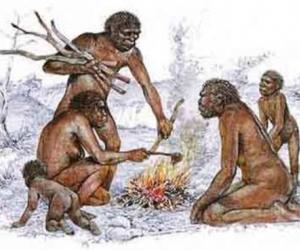
Our ancestors lived their lives in smoke from burning wood and cooking meat. This ability to resist the effects of smoke has passed onto modern day humans, decedents of Homo sapiens, through genetic mutation. As Neanderthals did not have this protection, they went extinct around 40,000 years ago.
According to lead researcher Professor Gary Perdew from Pennsylvania State University, Neanderthals inhaled smoke and ate charcoal broiled meat. They would have become exposed to various sources of polycyclic aromatic hydrocarbons that are known to be carcinogens and causes high level of cell death.
It is known that both modern humans and Neanderthals used fire for cooking and to keep themselves warm. Thus, it is believed that if Neanderthals were inhaling toxic filled smoke, they would have suffered from respiratory problems. Women would have experience problem with reproductive capacity. Other problems that the primate would have faced are: susceptibility to respiratory viruses among pre-adolescents.
According to co-author Dr George Perry from Pennsylvania State University, our hominin ancestors were probably using fire at least a million years ago. Some even have a hunch that the ancient humans used fire about two million years ago. This tolerance has continued in modem day people, making them unaffected by the smoke.
“We thought the differences in aryl hydrocarbon receptor ligand sensitivity would be about ten-fold, but when we looked at it closely, the differences turned out to be huge. Having this mutation made a dramatic difference. It was a hundred-fold to as much of a thousand-fold difference”, said Professor Perdew.
A report published in Breaking News revealed, "A genetic mutation may have given our ancestors an evolutionary advantage in the kitchen, new research suggests. It made them more immune to the effects of toxic chemicals produced by cooking meat and burning wood, say scientists."
“The evolutionary hypothesis is, if Neanderthals were exposed to large amounts of these smoke-derived toxins, it could lead to respiratory problems, decreased reproductive capacity for women and increased susceptibility to respiratory viruses among pre-adolescents, while humans would exhibit decreased toxicity because they are more slowly metabolising these compounds.”
“Cooking with fire could have allowed our ancestors to incorporate a broader range of foods in our diets, for example, by softening roots and tubers that might otherwise have been hard to chew. Cooking could also help increase the digestibility of other foods, both in chewing time and reduced energetic investment in digestion.”
According to a report in IB Times by Hannah Osborne, "A genetic mutation that made our early human ancestors more tolerant to smoke toxins may have given us the evolutionary edge of Neanderthals. Scientists have found key differences in a receptor involved in the body's response to certain toxins that made humans better able to cope with smoke exposure, meaning they could better harness it for their development."
They compared the genetics of polycyclic aromatic hydrocarbon (toxins found in smoke) in humans, Neanderthals and Denisovans (another hominin species more closely related to Neanderthals).
"We thought the differences in aryl hydrocarbon receptor ligand sensitivity would be about ten-fold, but when we looked at it closely, the differences turned out to be huge," said Perdew. "Having this mutation made a dramatic difference. It was a hundred-fold to as much of a thousand-fold difference."
Scientists has found explanation to what makes black holes found in the center of galaxies to produce X-ray bursts that are known as a cosmic X-ray background and more informally X-ray songs produced by a million supermassive black holes together...

A new study by the Massachusetts Institute of Technology (MIT) has revealed that Istanbul lies...

During the course of Thursday proceedings in the ongoing legal scuffle between Google and Oracle...

In an announcement made via a Twitter post published last Thursday, Tesla Motors’ CEO Elon Musk said that the electric vehicle manufacturer has efforts underway to make changes to the radar system in its vehicles.
The changes being planned...

The drought conditions in California is widening economic split in California. The prospect of...

In an announcement made on Tuesday, tech giant Google announced the launch of a new project --...

In recent years, gender gap in pay has been a hot topic of discussion. On Wednesday, Amazon. com Inc said its female employees are paid equally as their male counterparts. The results which came from a recent survey were disclosed under pressure...

In the recent years, the US space agency NASA has taken...

Several astronomers worldwide and NASA’s planet-hunting...

A new State of the Lake report expressed concern over...

The US space agency NASA has asked for a second crewed...
© 2011 AustrianTribune - Tribune Online Services. All times CET (GMT + 1.00).


