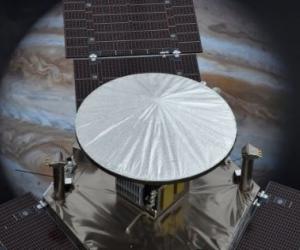
With the successful completion of another milestone, Juno has now stepped into the second phase of Jupiter’s orbit. After reaching the farthest point into the orbit, it is now falling back.
Now, the US space agency’s scientists have turned off all the equipments which will be activated once Juno will enter into biggest planet of our solar system. It will fall in the direction of the planet freely.
NASA launched Juno on 5 August 2011, and it arrived on Jupiter after nearly half decade after it.
According to Scott Bolton, Juno’s Principal Investigator at the Southwest Research Institute in San Antonio, from last about five years, they have been trying to reach the gas giant, and now, they are finally there. Bolton said that they are focused on starting dozens of flybys of the gas giant to get the science they are looking forward to.
The mission has been planned in a way that Juno needs to complete its one round around Jupiter by August 27 at 2,600 miles over the planet.
At the time of the orbit insertion, the science instruments of the spacecraft were turned off to make spacecraft operations simpler during the perfect maneuver, allowing the planet’s gravity to capture the spacecraft into orbit.
Rick Nybakken, Juno project manager at NASA’s Jet Propulsion Laboratory, Pasadena, California, said, “We’re in an excellent state of health, with the spacecraft and all the instruments fully checked out and ready for our first up-close look at Jupiter”.
With the beginning of the ‘get the science’ mission, the science instruments are going to start functioning to collect all the parameters of Jupiter. The data collected by the spacecraft will aid the NASA scientists in knowing the planet better.
According to a report in The Register by Simon Sharwood, "Each capture orbit will consume about 53 Earth days, meaning we are now 26 days from Juno's closest encounter with Jupiter. That pass, scheduled for August 27th, will see the probe graze Jovian clouds at an altitude of just 4,200km."
When Juno arrived at Jupiter, NASA left most of its instruments off so it could focus on manoeuvres. Now the probe's eyes are wide open, the better to drink in the amazing views that will come with this close encounter.
Mission scientists are celebrating passing apojove hard, as it's just a few days shy of the fifth anniversary of Juno's August 5th, 2011, launch. The craft will see a sixth birthday, but not a seventh: it's planned to “de-orbit” in January 2018, when it will plunge into the Jovian clouds never to return.
A report published in News Nation revealed, "Moreover, NASA scientists have switched off all the equipment which will be reactivated once the Juno makes its entry into the largest planet of our solar system. It will freely fall towards Jupiter."
Scott Bolton, Juno’s Principal Investigator at the Southwest Research Institute in San Antonio, said “For five years we have been focussed on getting to Jupiter. Now we are there, and we are concentrating on beginning dozens of flybys of Jupiter to get the science we are after”.
The “get the science” mission starts today, the science instruments will start working and will collect all the parameters of the giant planet. The information collected by it will help the scientists of NASA to know the planet better.
In the recent years, the US space agency NASA has taken bold steps in the direction of crewed Mars exploration. But, a new audit suggested that the agency could be moving quite hastily.
Last week, the Government Accountability Office (GAO...

A new study by the Massachusetts Institute of Technology (MIT) has revealed that Istanbul lies...

During the course of Thursday proceedings in the ongoing legal scuffle between Google and Oracle...

In an announcement made via a Twitter post published last Thursday, Tesla Motors’ CEO Elon Musk said that the electric vehicle manufacturer has efforts underway to make changes to the radar system in its vehicles.
The changes being planned...

The drought conditions in California is widening economic split in California. The prospect of...

In an announcement made on Tuesday, tech giant Google announced the launch of a new project --...

In recent years, gender gap in pay has been a hot topic of discussion. On Wednesday, Amazon. com Inc said its female employees are paid equally as their male counterparts. The results which came from a recent survey were disclosed under pressure...

A child in Siberia has lost life after an outbreak of...

Scientists has found explanation to what makes black...

The days of NASA's Cassini spacecraft could be numbered...

In the recent years, the US space agency NASA has taken...
© 2011 AustrianTribune - Tribune Online Services. All times CET (GMT + 1.00).