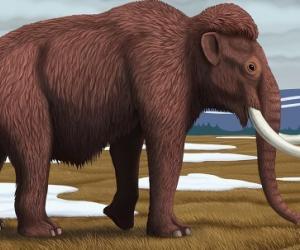
Not all the woolly mammoths went extinct in North America over 10,000 years ago; some were still thriving until about 5,600 years ago before disappearing. Those who lived for longer inhabited in islands. A study went onto discover what led to the extinction of mammoths in the remote Saint Paul Island in Alaska about 5,600 years ago.
No it was not human who killed them because human only discover the island in 18th century. According to the study published in the journal Proceedings of the National Academy of Sciences, it was scarcity of fresh water that killed the ancient species. They probably died of thirst. Rise in sea level left island to shrink to about 40 square miles, which is its current size, over the millennia. This means reducing space also reduced the resources for animals thus eventually killing them.
Shallow lakes had been source of fresh water for island creatures. But rise in the level of ocean would have resulted into seepage of salt water into limited sources of fresh water such as lakes. The dry climate condition was contributing to already existing problem. Dry weather further reduced the availability of fresh water.
In addition, mammoths too played a role to bring their own extinction. They were feeding on all the vegetation around the lakes likely causing erosion. The researchers of the study found remains of mammoth a cave on the island. They extracted sediment cores from a lake near the cave.
“They were actually causing the lake to infill – it's sort of an ironic situation. They sort of hastened their own demise”, said study lead author Russell Graham, a vertebrate paleontologist and geoscientist at Pennsylvania State University.
According to a report in CS Monitor by Eva Botkin-Kowacki, "On the remote Saint Paul Island in Alaska, mammoths went extinct only about 5,600 years ago, according to a new study published in the journal Proceedings of the National Academy of Sciences. And scientists think they know what killed them."
"Freshwater resources look like the smoking gun for what pushed them into this untenable situation," said Matthew Wooller, director of the Alaska Stable Isotope Facility at the University of Alaska Fairbanks and a co-author of the study, in a press release.
At the same time, the climate was getting drier, so the mammoth's drinking water supply was shrinking even without the sea's influence: bad news for the huge, thirsty animals. And the mammoths weren't making life easier for themselves, say the researchers. They found evidence that the megafauna were eating up all the vegetation around the lakes, which would have caused erosion.
A report published in Extreme Tech revealed, "Woolly mammoths generally went extinct between 10,000 and 14,000 years ago, along with the majority of the Pleistocene megafauna. There are, however, two known exceptions. Mammoths persisted on two islands: Wrangel Island, a Russian island in the Arctic Ocean, and Saint Paul Island, off the Alaskan coast."
The two major reasons for why megafauna like the mammoth went extinct are thought to be climate change and human predation. As the climate warmed, humans expanded into new territories that were formerly blocked by ice or too harsh to sustain life on an ongoing basis. The populations on Saint Paul and Wrangel survived as long as they did partly because they were isolated from humans and weren’t hunted for food.
The research team collected mammoth remains from a cave on St. Paul and took sediment samples from a nearby lake. They then analyzed the sediment samples looking for the spores of fungi that live on the island and preferentially reproduce in animal dung. Elephants are famous for producing mammoth amounts of dung and the sediment samples reflected this up to about 5,600 years ago.
In the recent years, the US space agency NASA has taken bold steps in the direction of crewed Mars exploration. But, a new audit suggested that the agency could be moving quite hastily.
Last week, the Government Accountability Office (GAO...

A new study by the Massachusetts Institute of Technology (MIT) has revealed that Istanbul lies...

During the course of Thursday proceedings in the ongoing legal scuffle between Google and Oracle...

In an announcement made via a Twitter post published last Thursday, Tesla Motors’ CEO Elon Musk said that the electric vehicle manufacturer has efforts underway to make changes to the radar system in its vehicles.
The changes being planned...

The drought conditions in California is widening economic split in California. The prospect of...

In an announcement made on Tuesday, tech giant Google announced the launch of a new project --...

In recent years, gender gap in pay has been a hot topic of discussion. On Wednesday, Amazon. com Inc said its female employees are paid equally as their male counterparts. The results which came from a recent survey were disclosed under pressure...

A child in Siberia has lost life after an outbreak of...

Scientists has found explanation to what makes black...

The days of NASA's Cassini spacecraft could be numbered...

In the recent years, the US space agency NASA has taken...
© 2011 AustrianTribune - Tribune Online Services. All times CET (GMT + 1.00).