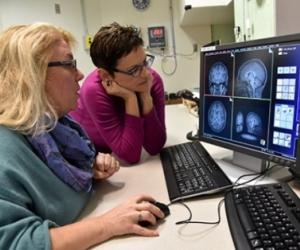
A latest study conducted by researchers from the University of Hawaii in Honolulu has found that children who are APOE e4 carriers showed negative impacts on brain development and brain aging depending on their specific genotype.
Reported online in the journal Neurology, the study examined 1,187 healthy children aged 3 to 20 years. Those with the e4e4, e2e2, and e2e4 genotypes had altered age-related slopes in brain regions often affected in Alzheimer's disease.
Linda Chang, MD, of the University of Hawaii in Honolulu, and colleagues reported in the journal: "This large sample of children validated and extended prior smaller studies that showed altered brain development in e4 carriers.
The e4e4 and e2e4 carriers appear to show the strongest antagonistic pleiotropic effects, with negative influences on brain structures and cognition at younger age, mirroring those in elderly participants and patients with AD, they wrote.
The researchers noted that smaller hippocampal volumes seen in younger e2e4 children and lower hippocampal fractional anisotropy seen in younger e4e4 children mirror the smaller volumes and steeper age-dependent atrophy of the hippocampi in elderly e4 and e2 carriers.
They found that younger e4e4 children had the lowest scores on executive function and working memory and younger e2e4 children performed worse on attention tasks.
Poorer performance on attention or working memory was predicted in larger parietal gyri in the younger e2e4 children, and thinner temporal and cingulate isthmus cortices or smaller hippocampi in the younger e4e4 children.
The future studies of the APOE polymorphisms in young children may flag risk of future brain injuries and dementia. Each genotype should be evaluated separately, they suggested, since brain development as well as aging and recovery may vary significantly across specific e4 or e2 genotypes. A thorough understanding of how AD risk genes, such as APOE e4, might interactively or independently influence the brain across the ages is needed.
"Medical research has discovered that two proteins found in the brain are important in causing Alzheimer's disease. The first is called amyloid-beta. This protein clumps together to form plaques in the brain. These plaques have long been recognized as a hallmark of Alzheimer's disease," according to a recent Billings Gazette report.
Recently, new potential treatments have focused on a different protein: tau. Tau clumps together in the brain to form what are called "tangles." Like the plaques of amyloid-beta, the tau tangles have long been a hallmark of Alzheimer's disease. Tau helps to transport nutrients into the cells and to move waste out of cells.
However, when tau protein forms tangles, brain cells have trouble getting enough nutrients and eliminating waste. As a result, brain cells slowly die. In a recent report in the journal Brain, researchers examined the brains of more than 3,600 people who had died. They concluded that the presence of dysfunctional tau protein may be more important than amyloid-beta in causing the cognitive decline and memory loss seen in Alzheimer's.
According to a report in Medpage Today by Kristin Jenkins, "In a study of 1,187 healthy children ages 3 to 20, those with the e4e4, e2e2, and e2e4 genotypes had altered age-related slopes in brain regions often affected in Alzheimer's disease, Linda Chang, MD, of the University of Hawaii in Honolulu, and colleagues reported online in Neurology."
In the future, they added, studies of the APOE polymorphisms in young children may flag risk of future brain injuries and dementia. Each genotype should be evaluated separately, they suggested, since brain development as well as aging and recovery may vary significantly across specific e4 or e2 genotypes.
"Given the urgent need to determine how early patients with AD should receive interventions or preventive treatments, a thorough understanding of how AD risk genes, such as APOE e4, might independently or interactively influence the brain across the ages is needed," they wrote.
According to a story published on the topic by Express, "Young children with the inherited gene linked to Alzheimer's disease are said to have smaller memories and be only able to do half as well in thinking and memory tests as those without it. This new discovery could help doctors in the future to identify the people most at risk of developing the condition and be able to do something about it earlier."
It was made sure that none of the children taking part in the research has brain disorders or other problems which would affect their brain, and they were then tested to see which version of APOE they had. One variant called APOE4 has been linked to a higher risk of people developing Alzheimer's disease.
Children with the gene were discovered to have done worse in the memory and thinking skills tests. But after eight years old, even children who had been passed on the APOE4 fro both parents had normal test scores.
Until now, scientist believed that there had been one unknown group of ancient people from Stone Age that introduced farming practices all over the world. However, ancient human remains collected from a site in the Zagros Mountains in present...

A new study by the Massachusetts Institute of Technology (MIT) has revealed that Istanbul lies...

During the course of Thursday proceedings in the ongoing legal scuffle between Google and Oracle...

With a 2015 Tesla Model S electric sedan having been involved in a fatal crash when driven in automated mode in May, advocates of self-driving cars are now scrambling to contain the fallout of the crash.
The fatal crash took place on May...

The drought conditions in California is widening economic split in California. The prospect of...

In a recently released blog post, tech biggie Google has revealed that its 2015-launched ‘...

German drugmaker Merck said that its experimental cancer medicine evofosfamidehas failed in the last stage of clinical tests due to which it won't seek regulatory approval for its treatment.
On Monday, Darmstadt, Germany-based Merck said...

Researchers from Stanford University School of Medicine...

The Sloan Digital Sky Survey III (SDSS-III) has come up...

Marine ecologist Neil Hammerschlag was conducting...

Whether it’s about Amazon deliveries or racing...
© 2011 AustrianTribune - Tribune Online Services. All times CET (GMT + 1.00).