


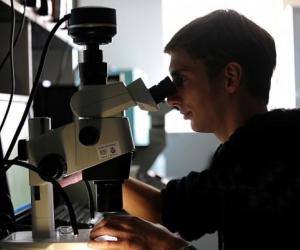
A team of scientists are planningto send thousands of microscopic worms to the International Space Station (ISS) for experiments.
Scientists are trying to determine what triggers the body to build and lose muscle. Three new experiments led by UK research teams for sending lifeforms to the ISS were selected for further consideration. The experiments will be coordinated by Nasa, the European Space Agency (ESA), and the Japanese and Canadian space agencies.
One experiment, which is led by Dr Timothy Etheridge of Sport and Health Sciences at the University of Exeter, is aiming to use a nematode worm species called Caenorhabditiselegans, which are useful for studying long term changes in human physiology as they face muscle loss under similar conditions in which humans face muscle loss. The experiment is likely to be conducted between 2017 and 2020.
Experts said that these microscopic wormswill be placed in small bags of liquid food and taken to the ISS. These worms will be allowed to live and produce offspring for five and a half days before they are frozen and brought back to Earth for analysis.Muscle weakness and reduced muscle mass is a regular problem in spaceflight but findings may have wider potential application to help people with dystrophy and diabetes, people immobilised by casts and the elderly.
In a recently published blog post, "social media theorist" and Snapchat researcher Nathan Jurgenson has revealed that Snapchat is funding a new online magazine called 'Real Life.'
In announcing that Snapchat is bankrolling the new 'Real...

A new study by the Massachusetts Institute of Technology (MIT) has revealed that Istanbul lies...

During the course of Thursday proceedings in the ongoing legal scuffle between Google and Oracle...

Paying in cash is any day better than taking a loan from a loan shark. In good old days people used a wad of cash to pay everything starting from furniture to grocery, if they did not have enough, they would wait for something cheaper or for the...

In January, trade surplus of Germany decreased since plunge in imports was more than a drop in...

In an apparent attempt to enhance the visual experience for Google search users carrying out...

German drugmaker Merck said that its experimental cancer medicine evofosfamidehas failed in the last stage of clinical tests due to which it won't seek regulatory approval for its treatment.
On Monday, Darmstadt, Germany-based Merck said...

In a recently published blog post, "social media...

With tech giant Google scheduled to launch the Play...

Monohm Inc.’s incredibly weird circular smartphone-cum-...
© 2011 AustrianTribune - Tribune Online Services. All times CET (GMT + 1.00).


