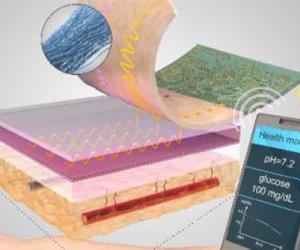
Significant advancements are being made that can be used for implantable medical technology. One of them has been made by engineers at Tufts University. They have made a smart thread that can be woven into human tissue to collected diagnostic data.
There is a difference between a conventional implantable technology, which remains restricted to a specific purpose, and thread, as it can have an access to multiple layers of tissue. The threads can be conductive in nature, meaning that it can deliver data to flexible wireless transmitted present on person’s skin.
Sameer Sonkusale from Tufts School of Engineering has strong hopes from thread-based devices as he thinks that they could be used as smart sutures for surgical implants or smart bandages to keep a tab of wound healing.
“The ability to suture a thread-based diagnostic device intimately in a tissue or organ environment in three dimensions adds a unique feature that is not available with other flexible diagnostic platforms”, mentioned Sonkusale.
The team’s main motive to design the thread was to treat wounds, especially from those due to diabetes. Sonkusale said that chronic wounds owing to diabetes prove quite taxing for healthcare. A need was felt to come up with sensors that monitor wounds to check whether or not the infection is healing.
Currently available sensor platforms are restricted to limited surfaces, like skin. The research team has developed many threads to perform sensing functions. Each of the thread was having its own purpose. In order to communicate the information on a mobile phone and the internet, the research team has used a wireless transmitted present on the skin’s top. The threads need to undergo at least five to 10 years of strict testing and then they could be used on human patients.
According to a report in VOA News by Jessica Berman, "Someday soon, a doctor may stitch a tiny piece of thread into your skin, to reveal whether a wound is healing properly or becoming infected. Researchers have developed a “smart” thread that collects and wirelessly transmits vital data. Nano-scale sensors and electronics are infused into the thread, which can be made of cotton or synthetic material, by dipping it into a variety of physical and sensing compounds."
“You can monitor, let’s say, glucose, which we demonstrated. You can monitor pH, you can monitor sodium and potassium ions,” said Sonkusale. “Then you have different threads that you can literally suture on a bandage, on a bandaid, or even a wound that you can place on a healthy skin and monitor your own metabolic activity. You athletes would like to monitor how well they perform. So this could also be used as a wearable sensor platform for an otherwise healthy adult.”
The researchers have attached to the thread an extremely thin wire that transmits data to a portable device. “It’s almost the width of a human hair outside the tissue," Sonkusale explained. "And there it’s connected to circuit board, a flexible circuit board which has been assembled on a fabric that wirelessly transmits that information to a cell phone. So you have real time access to biomarkers that’s inside the tissue.”
A report published in the The Verge said, "Visions of the future of medicine often involve digital sensors that constantly monitor patients, but not many people imagine that these sensors could be stitched directly into us. But that's the suggestion of a team of researchers from Tufts University, who have developed prototype "smart stitches" that can be used to close wounds — but also send real-time data on tissue health to doctors."
By combining these two threads with other materials, the scientists were able to create stitches and bandages with an array of different functions. These include gauging the amount of strain exerted on muscle (done by coating threads with a material that conducts more or less electricity based on whether it's being stretched), and measuring the pH, or chemical composition, of the tissue (done by wicking liquid from the wound to a sensor on the exterior of the skin).
Rickard Ignell, a professor at the Swedish University of Agricultural Science, carried out a research in Ethiopia with the aim of finding a solution for prevention against malaria. This disease is an extremely important health concern across the...

A new study by the Massachusetts Institute of Technology (MIT) has revealed that Istanbul lies...

During the course of Thursday proceedings in the ongoing legal scuffle between Google and Oracle...

The vehicle recall proposal submitted by German automaker Volkswagen AG (VW) for 85,000 diesel-powered vehicles affected by the emissions-cheating scandal has been rejected by the California Air Resources Board
(CARB).
In rejecting...

The drought conditions in California is widening economic split in California. The prospect of...

Security researchers from Ben-Gurion University Cyber Security Research Center (CSRC) have...

In recent years, gender gap in pay has been a hot topic of discussion. On Wednesday, Amazon. com Inc said its female employees are paid equally as their male counterparts. The results which came from a recent survey were disclosed under pressure...

A novel brain map has been developed on the basis of...

Toby Spribille fell in love with science at a young age...

Rickard Ignell, a professor at the Swedish University of...

A study, published last week, noticed a surge in number...
© 2011 AustrianTribune - Tribune Online Services. All times CET (GMT + 1.00).