Graphene has been talked about a lot to bring a revolution in conductors. However, graphene, an atom-thick sheet of carbon, lacks a much needed bandgap required to become a superconductor. The bandgap is central to modern electronics and its absence has worried researchers over use of graphene in future to bring copper wire conductors to an end.
Now, researchers at the Georgia Institute of Technology have claimed that graphene could be brought to electronics by a employing a new kind of switch.
Graphene nanoribbons have property known as ballistic transport. This means, electrons can be transferred similar to how photons travel in an optical cable. The best thing is that the electrons will be travelling at high speed with low resistance, and with little scattering.
Researchers found that touching an electrical probe to graphene nanoribbons leads to scattering of electrons and increase resistance.
A new kind of electronics switches for the material can be created because of the ability to affect the resistance of the nanoribbons. Also, it is a possibility that such switches could be used to create graphene-based electronics.
Scientists have not been able to build graphene-based electronics that could emulate silicon superconductor chips. But nevertheless, scientists have capitalized on their findings really well and now they have invented a new form of graphene that's ten times more conductive.
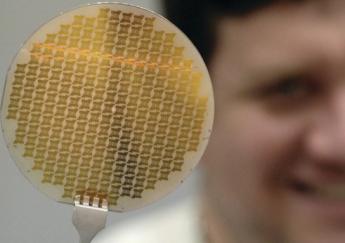
They actually devised a way to allow electrons to act like photons in this new form of graphene. Nanoribbons were grown by the scientists on silicon carbide wafers. They had also etched circuit patterns with the help of standard microelectronics techniques. After the silicon was heated at about 1,000º Celsius, the silicon melted and left the novel graphene nanoribbons with perfectly smooth edges. Then formation of graphene took place on the etched edges of the silicon.
The smoothness is so effective that it allows the electrons to move along the graphene with virtually no resistance.
"These electrons are really behaving more like light. It is like light going through an optical fiber. Because of the way the fiber is made, the light transmits without scattering", said Walt de Heer, a professor at the Georgia Institute of Technology, who worked on the study.
Graphene has been talked about a lot to bring a revolution in conductors. However, graphene, an atom-thick sheet of carbon, lacks a much needed bandgap required to become a superconductor. The bandgap is central to modern electronics and its...

An EU-funded research project was launched by Berlin the previous week. This project was...

During the course of her address at Intel's Datacenter Day on Monday, Diane Bryant - general...

Mexican billionaire and business tycoon Carlos Slim is looking forward to consolidate his company and family stakes in Telekom Austria. He has given a signal to regulators about his position. The regulators monitor that when stake-holdings attain...

According to a latest report, the new Finance Minister Michael Spindelegger has recently...

If talked in the truest senses, it's Erwin Schrodinger, who by his amazing contribution has...
Mexican billionaire and business tycoon Carlos Slim is looking forward to consolidate his company and family stakes in Telekom Austria. He has given a signal to regulators about his position. The regulators monitor that when stake-holdings attain...

A spinning planet has been discovered by researchers...

Scientists have claimed that they have found the precise...

The Centers for Disease Control and Prevention (CDC) has...
© 2011 AustrianTribune - Tribune Online Services. All times CET (GMT + 1.00).