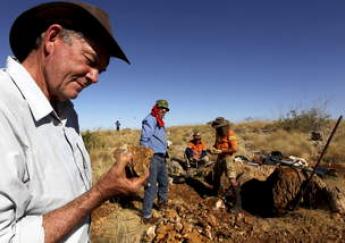
Palaeontologist, Dr. Michael Archer, has been suspecting if it were not for the satellite technology, he would have been on an isolated outcrop only in north-west Queensland.
While an untrained eye would see a baseball-sized rock carried by the palaeontologist as congealed dirt, experts believe that the same had hints to an essential time, though unknown, in the history of the continent.
It has been found that flecks of white bone could barely be seen on the surface of the rock. These have, however, been identified by a group of scientists as the teeth and limbs of many distinct primitive mammal groups. These first had been discovered in the fossil record back over 20 million years.
The rock is being studied by Michael Archer and his colleagues from the University of NSW by searching through the dust and dirt of Riversleigh. Piles of silt-covered rocks have been extracted by them from a small pit that was unveiled last year next to the Riversleigh World Heritage fossil site.
"While the known fossil deposits span environmental change over the last 25 million years, there are some `holes' in the record including the period about 13 to 5 million years ago", Professor Archer was cited as saying.
Private space-flight company SpaceX's reusable rocket Grasshopper earlier this week showed its capability of performing more aggressive steering maneuvers than what is had demonstrated in previous flights.
The rocket on Tuesday flew to a...

A rail tunnel's trial run has been successfully accomplished by Turkey. The tunnel connects the...

During the course of her address at Intel's Datacenter Day on Monday, Diane Bryant - general...

In a move which marks Mercedes-Benz's efforts to ramp up a small-car offensive, the automaker is set to unveil its new compact crossover - the `GLA-Class' - at the Frankfurt International Motor Show in September.
The 14.5-feet long, and...

On Saturday, Europe failed to agree on how to share the cost of bank collapse on Saturday....

Retailer Best Buy has recently launched a pre-order system for Google's new updated Nexus 7...

In more than four years, the biggest single-day gain has been noted by Telekom Austria AG (TKA). It is reportedly after the proposal of conquest of Royal KPN NV. (KPN) put forth by the Mexican billionaire's company.
As per the findings,...

If the Nazis had won World War II, Germany would have...

Zombies thrive in the Antarctic and it is the one region...
© 2011 AustrianTribune - Tribune Online Services. All times CET (GMT + 1.00).