


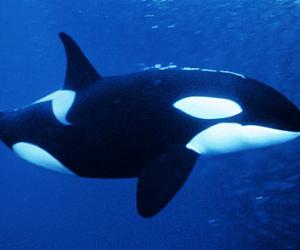
Ever since the Puget Sound's southern-resident killer whales came under the Endangered Species Act (ESA), scientists have found out where orcas go in winter. They have also learned that these whales can differentiate a chinook from a sockeye by using sonar to detect little differences in the swim bladder of each fish. Researchers have also documented many ways in which these majestic mammals shift their behaviour in response to engine and propeller noise from the boats.
According to a new synopsis of research done by the National Oceanic and Atmospheric Administration (NOAA),despite the vast knowledge about them, the killer whales were still listed as endangered in 2005 and the orca population is still not growing.
Scientists are "trying to understand ... why the whales haven't increased more than they have", said Mike Ford who is with the conservation biology program at NOAA's Northwest Fisheries Science Centre.
A study in whale science reveals that orcas face quite complex and overlapping threats that tend to compound one another.
In the early 1960s, the killer whales were numbered 140 and some scientists also suspect that a century before that there might have been 200 or more than that. By the early 1970s when the entrepreneurs began capturing orcas for sale to marine parks, their population plummeted to barely 71. Then, capture was outlawed after a few years and orca populations reached 99 somewhere in the mid-1990s.
As of 2013, only 82 remain.
There are three main factors that appear to contribute to their decline: lack of food, disturbance due to marine vessels and the build up of pollutants in their bodies.
These majestic mammals are already among the most polluted animals on the Earth due to toxins accumulating in their fat over years. When whales get hungry, contaminants mobilize in their system which potentially affects their health as well as the reproduction.
Scientists at American space agency, NASA have said that the newcarbon dioxide tracking satellite is now operational.
The new mission, which will cost $468 million, is aimed at studying in driver of climate change emitted from smokestacks...

An EU-funded research project was launched by Berlin the previous week. This project was...

Sportswear giant Nike has recently announced the launch of a companion Android app for its...

According to a Reuters report, tech giant has recently joined the AllSeen Alliance as a Premier Member. The AllSeen Alliance is considered as the broadest open-source project related to the so-called 'Internet of Things.' It was started by the...

The European Union’s statistics agency, Eurostat, reported on Wednesday that there was stagnancy...

On Thursday night, six Google Glass 'Explorers' - that is, early adopters of Google's futuristic...

AT&T has revealed in a recent announcement that it is launching Voice-over-LTE (or VoLTE) and HD Voice support in the US. The combination of the two new features announced by AT&T is expected to bring about an improvement in phone calls...

German specialists say they have treated a Motorhead fan...

A new study has doubted the existence of two of the...

The possibility of landing a human on Mars is one step...

Three month old Joanne, the youngest gorilla at the San...
© 2011 AustrianTribune - Tribune Online Services. All times CET (GMT + 1.00).


