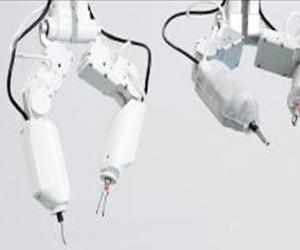
Virtual Incision Corporation and researchers from University of Nebraska-Lincoln have developed a fist-sized robot that is expected to prove beneficial for future astronauts as well as for other space explorers who live in space for longer time periods.
This tiny robot can slip in person's body through small belly button incision. It works by inflating the patient's abdominal cavity with an inert gas. Its two arms boast of multiple tools that can rupture gastric ulcers, can perform emergency appendectomies and stitch wounds.
The compact robot will be sent for its first zero-gravity test in next several months. It is a significant step towards making robotic medical assistance a possibility for humans who are on deep-space missions lasting for long time.
The robot would be controlled through a human operator, who would be using two Phantom Omni haptic devices. The devices will provide feedback, a foot pedal and a monitor. It would be during the test run in which a parabolic flight would mimic zero-gravity by diving that the surgeon user interface and robot will get a chance to exhibit human-robotic coordination.
Experts said assistance of robot in emergency situation is considered to be a rare opportunity. Such incidents have taken place at remote locations during Arctic or Antarctic expeditions and military submarine service.
With passage of time, things are getting advanced and this innovation suggests that astronauts and space explorers can be benefitted while they live at remote places far from Earth like remote moon bases or Mars colonies.
Guests on a cruise sponsored by Chicago's Shedd Aquarium and Un-Cruise Adventures got to rare chance to feast their eyes on two oarfish in the shallow waters along the coastline of Baja, Mexico.
A video of the sea creatures posted on...

An EU-funded research project was launched by Berlin the previous week. This project was...

During the course of her address at Intel's Datacenter Day on Monday, Diane Bryant - general...

In a partnership which will enable German operator Deutsche Telecom (DT) to expand its network coverage, the company has joined forces with crowdsourced Wi-Fi Hotspot provider Fon for building what it claims will be the biggest Wi-Fi hotspot...

According to a latest report, the new Finance Minister Michael Spindelegger has recently...

French physicist Jean Bernard Léon Foucault created a Foucault pendulum in 1851. A lot of...
In a partnership which will enable German operator Deutsche Telecom (DT) to expand its network coverage, the company has joined forces with crowdsourced Wi-Fi Hotspot provider Fon for building what it claims will be the biggest Wi-Fi hotspot...
A 10-year study by researchers from Arizona State...
The discovery of 520-million-year old three-inch-long...
This year's NASA annual International Space Apps...
© 2024 AustrianTribune.